

Everybody in the match is on the same map, and the map is the thing the game says least about. Weapons publish damage. Modes publish round counts and timers. Maps publish a name and a picture.
What comes with a map
Three pieces of art each, doing three different jobs in the menus.
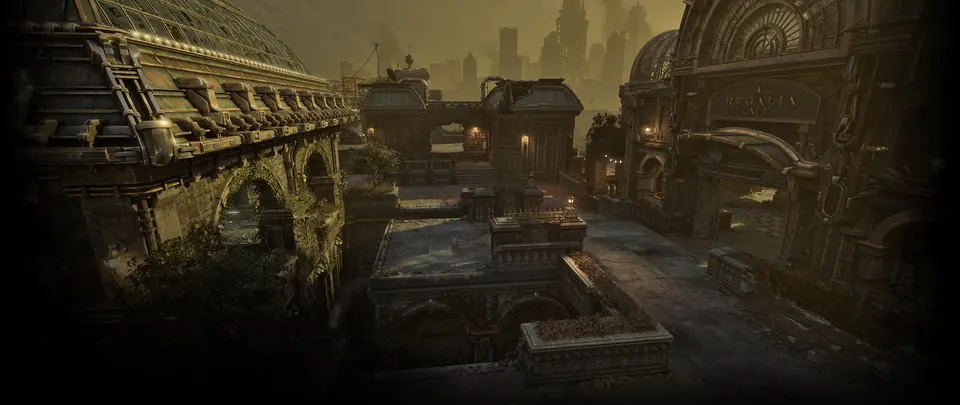
- Loading screen art 2560×1080 · the widest art in the game, and the only place you get a look at a map before you are in it.
- Map vote tile 330×400 · the portrait you pick from.
- World map thumbnail 572×352 · the map’s pin on a map of the city.
- Map description — The game writes none for any of the six.
Six maps times three is eighteen. There are nineteen.
Two maps answer to another name in their own art
Market’s artwork is Marche all the way through, and Outpost’s is Camp. In the game you see Market and Outpost, and Market’s vote tile has a lit neon sign over the street that reads MARKET, so you are never guessing in the menu.
It matters in one place. If you are matching a screenshot or a clip to a name, the picture may be captioned with the other one. One map with two names, not two maps.
What the artwork shows
Not a read of how any of them plays. Map names are the game’s own; the labels above them are unofficial.
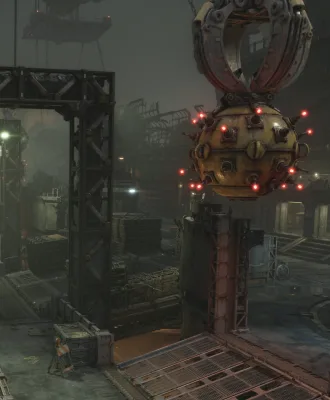 Drydock
Battleship
A crane holds a mine over the floor. The hull reads CNV Valiant.
Drydock
Battleship
A crane holds a mine over the floor. The hull reads CNV Valiant.
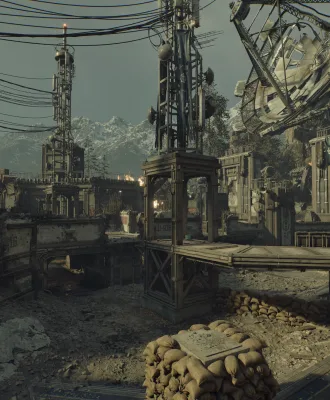 Hillside camp
Outpost
Comms masts, sandbags and timber walkways under snowy peaks.
Hillside camp
Outpost
Comms masts, sandbags and timber walkways under snowy peaks.
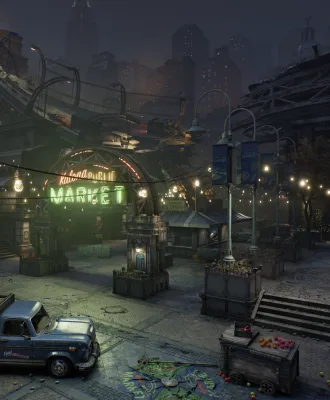 Night market
Market
Stalls under strung lights, and a neon arch reading MARKET.
Night market
Market
Stalls under strung lights, and a neon arch reading MARKET.
 Zoo
Park
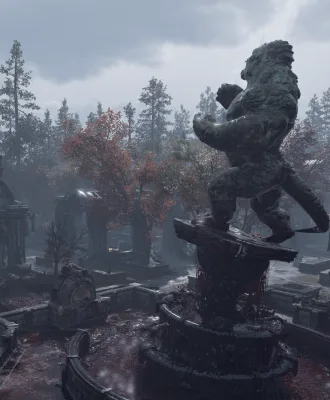
A stone bear on a fountain, autumn trees, banners reading ZOO.
Zoo
Park
A stone bear on a fountain, autumn trees, banners reading ZOO.
 Motor pool
Precinct
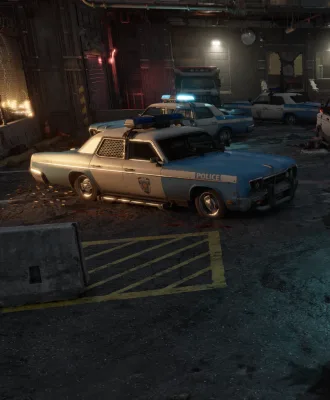
Squad cars parked indoors, concrete barriers, blood down a trunk lid.
Motor pool
Precinct
Squad cars parked indoors, concrete barriers, blood down a trunk lid.
 Glass roof
Skyward
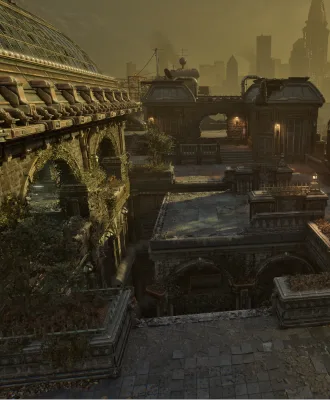
Terraces high over the city, and a gold sign reading Regalia Cafe.
Glass roof
Skyward
Terraces high over the city, and a gold sign reading Regalia Cafe.
Vote tiles, at the shape the game draws them; the captions read from all three pieces of each map, and the signage is on the wide loading screen art. All nineteen are on the Versus maps page at full size.
The nineteenth picture
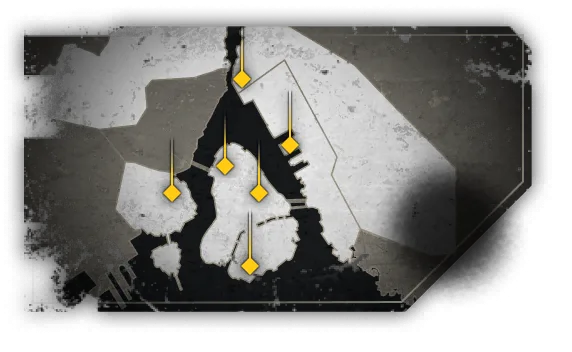
It belongs to no single map, and the August 11 update added nothing to the set.
What is not written down
No power weapon spawns. No lane counts. No map size, no recommended mode, no player count tied to a map. Not one of the six carries a line of published description. That part is still true for all six.
Callouts, the location names players call out to each other, are a different story now. All six maps have a tactical map with named callouts, taken from the game’s own overhead-map data rather than guessed from how players describe the map. When the game says something about a callout, it goes on the page.
The mode is the part that changes
The pool does not move, so the mode is what changes a map’s job, and mode rules are published in full. Every line here comes from the rule card the game shows you.
| Mode | Rounds | Round timer |
|---|---|---|
| Team DeathmatchLast team standing. 15 lives per team. | 2 to win | 10 min |
| ConquestHold a zone to capture it. Four zones wins. | Single | 25 min |
| DemolitionPlant the bomb and defend it. 60 second fuse. | 3 to win | 6 min |
| CrucibleHold the Core in the zone. Three zones wins the round. | 2 to win | 10 min |
| King of the HillIn rotation. Hold the zone for a cumulated 120 seconds. | Single | — |
| GuardianIn rotation. Last team standing wins the round. | 2 to win | 10 min |
| WarpathIn rotation. Capture the zone for points. 100 wins the round. | 2 to win | 10 min |
King of the Hill’s timer is a dash because its card does not give one. That is not the same as unlimited. Team size is nearly the same story: the playlist descriptions say 4v4, King of the Hill’s card says a 4 on 4 battle, and no other mode’s card carries a headcount at all.
One last thing decides which of the six you end up on. Social lobbies stay together between matches:
In the game’s words
“At the end of each match, players vote on the next map and mode, allowing lobbies to continue without re-entering matchmaking.”
Ranked has no equivalent.